






Serviette rings for any dining occasion.
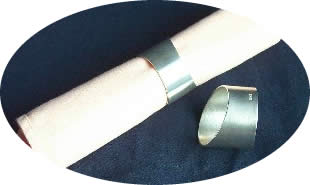
The user can utilise the Tubilar serviete holder at the dining or picnic table and when not in use they can be displayed in their own right.
Tubilar is decorated with contrasting shiny and matt tonal areas.
def. The napkin ring, sometimes called serviette ring, was originally used to identify
the napkins of a household between weekly wash days. The standard napkin ring is
a simple ring made from skewer. The figural napkin ring is an American speciality
in which the simple napkin ring is part of a small figure or sculpture that may
take any shape and show any motive. Napkin rings appear as single items with name
or initials of the owner, notably given as christening presents, or pairs often
given as gifts at weddings and silver weddings. In the English speaking countries
numbered sets of 4, 6, 8, 10 or 12 napkin rings are found. Napkin rings are an invention
of the European burgeoisie. First appearing in France about 1800 and soon spreading
to all countries in the western world. Most 19'th century napkin rings were made
of silver or silver plate, but examples were also made in bone, wood, pearl embroidery,
porcelain, glass, etc. In the 20'th century bakelite and other new materials were
used. Napkin rings are increasingly popular with collectors, yet only magazine articles
and no books exist on the standard napkin ring and very few internet sites are totally
devoted to napkin rings.
Available in:
Pewter, Silver Plate and Sterling Silver (wt. 2 oz Troy)
|

|
